
Determining the 1985 penny value requires a detailed study of production conditions, alloy composition, and the current US numismatic market state.
The 1985 issue is not rare by total mintage volume, shifting the primary pricing focus to exceptional preservation and specific manufacturing errors.
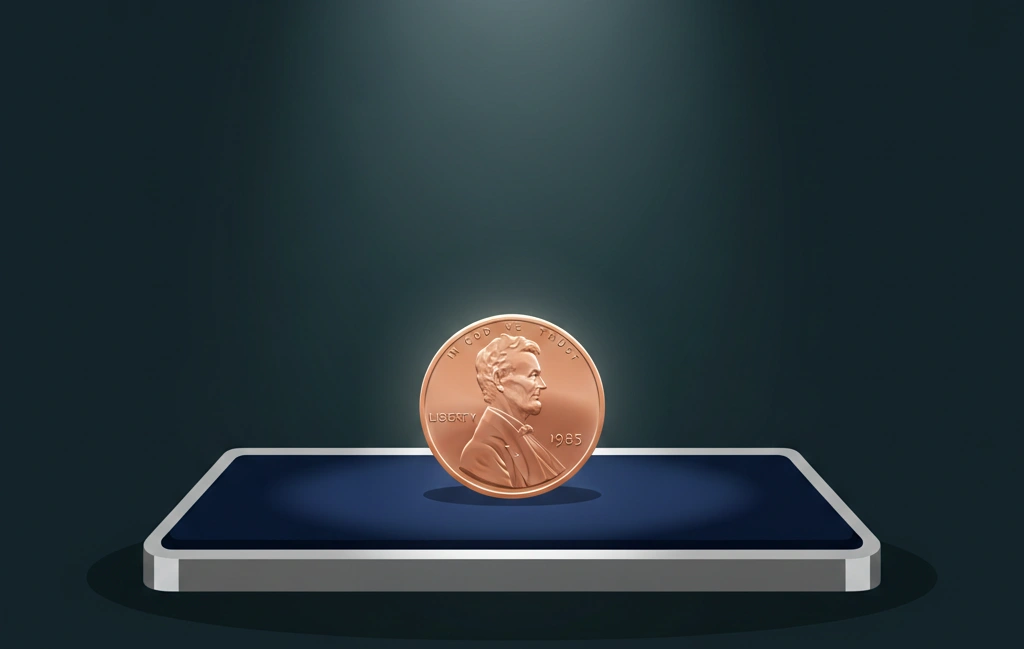
1985 coins were produced according to standards adopted after the change in cent composition in mid-1982.
Material: Zinc core (97.5%) plated with a thin layer of copper (2.5%).
Total Weight: 2.5 grams.
Diameter: 19.05 mm.
Thickness: 1.52 mm.
Edge Type: Plain.
Utilizing a zinc base makes these coins highly susceptible to corrosion. Zinc interacting with oxygen in the presence of micro-cracks in the copper plating leads to gas bubbles, significantly lowering the final grade of the coin.
Mintage Statistics by Mint Facility
The total production volume for 1985 exceeds 10 billion units, distributed among three branches of the US Mint.
Mint Facility | Mint Mark | Mintage |
Philadelphia | None | 5,648,489,887 |
Denver | D | 5,287,399,926 |
San Francisco (Proof) | S | 3,362,821 |
The colossal mintage volume in Philadelphia and Denver causes a lack of value for specimens found in circulation. The value of such coins is limited to their face value. Market interest remains concentrated exclusively on coins in Mint State (MS) 67 and higher.
Grading and Value Thresholds
Professional certification via PCGS, or a free coin identifier app, remains the only method for confirming high value for a 1985 penny.
Grade Distribution and Population
Currently, the number of certified coins in the highest preservation states remains limited relative to the total mintage.
MS-66: A mass category with prices fluctuating between 5–15 USD.
MS-67: A category having stable demand, valued from 20 to 80 USD.
MS-68: A rare preservation state characterized by the absence of visible defects under magnification.
MS-69: An exceptionally rare grade existing in very few specimens.
Copper-plated zinc coins rarely reach the MS-69 grade due to the softness of the metal, leading to contact marks occurring when falling into mint bins.
Record Auction Sales
Analyzing historical sales data allows for the recording of peak values for various 1985 cent types.
Sales Statistics for 1985 (No Mint Mark)
In 2014, a 1985 specimen graded PCGS MS-69RD was sold at Heritage Auctions for 5,875 USD.
In 2023, a similar coin in MS-68RD condition was sold for 312 USD.
Sales Statistics for 1985-D (Denver)
The record for the 1985-D was set in 2021 at 2,400 USD for an MS-68RD specimen.
The average price for an MS-67RD Denver cent is approximately 45–60 USD, demonstrating stability over the last 5 years.
Sales Statistics for 1985-S (Proof)
San Francisco coins were struck specifically for collector sets.
A specimen in PR-70 Deep Cameo grade sold for 345 USD in 2019.
The presence of numerous coins in PR-69 condition limits their price to the 8–12 USD range.
Value Change Dynamics in Percentages
Observing market cycles allows for the calculation of average annual value changes for high-preservation coins.
Coin Grade | 2015–2019 Change (%) | 2019–2025 Change (%) | 2026 Forecast (%) |
MS-67 (P/D) | +5% | +12% | +3% |
MS-68 (P/D) | +15% | +28% | +8% |
MS-69 (P) | +2% | +110% | Uncertain |
The sharp price increase for MS-69 in recent years relates to decreasing supply at auctions and rising grading service costs exceeding the nominal value of most coins.
Production Errors and Varieties
1985 mint errors increase coin value regardless of their overall grade. Identifying such defects requires the use of macro photography.
Doubled Die
In 1985, no major, widely known Doubled Die Obverse (DDO) errors comparable to 1955 or 1972 were recorded. Only minor cases of doubling on the word "LIBERTY" and the date exist. Such specimens are valued at 20–50 USD depending on defect visibility.
Off-Center Strike
The value of an off-center coin depends on the percentage of missing image and the presence of the date.
10–20% off-center (date visible): 15–30 USD.
50% or more off-center (date visible): 75–150 USD.
Die Cracks and Planchet Defects
Die cracks appearing as raised lines on the surface add between 2 and 10 USD to the coin's value. Plating issues exposing the zinc core are considered damage rather than valuable errors, reducing the value to face value.

The Role of the RD (Red) Index in Pricing
For copper and copper-plated coins, color is a critical factor. Certification centers assign one of three categories: RD (Red), RB (Red-Brown), BN (Brown).
For the 1985 cent, achieving an RD designation is mandatory for reaching a high price. A specimen graded MS-68BN will cost 5–10 times less than a similar MS-68RD. Surface oxidation turning the red color to brown irreversibly reduces the coin's investment appeal.
To understand the 1985 cent's place in the numismatic hierarchy, its indicators should be compared with those of 1984 and 1986.
1984: Features the well-known "Doubled Ear" variety, making it more sought-after when searching for errors.
1985: Distinguished by the absence of mass significant errors, concentrating the market on strike quality.
1986: Shows similar population reports for MS-68 but has a slightly lower record price for MS-69.
Impact of Inflation and Metal Value on Liquidity
The intrinsic metal value (melt value) of a 1985 cent is less than 1 US cent due to its zinc composition. This distinguishes it from pre-1982 cents, consisting of 95% copper and having an intrinsic metal value of about 2.5–3 cents.
Thus, 1985 coin liquidity depends entirely on collector's condition. Lacking an MS-67+ certificate, a coin is not considered an investment or collectible object.
Recommendations for Technical Evaluation
When conducting an analysis of a specific 1985 specimen, one should follow an algorithm excluding subjective factors.
Weighing the coin to confirm compliance with the 2.5 g standard.
Inspecting the surface for zinc bubbles occurring under the copper layer.
Evaluating luster — the coin must possess original mint frost or mirror-like surfaces without signs of cleaning.
Searching for mechanical damage on the date digits and lettering via a coin checker app.
Conclusion
The 1985 cent serves as an example of a coin whose value is generated solely by the scarcity of the highest preservation grades. Huge mintages make value growth impossible for 99.9% of existing specimens.
Investment potential remains only for coins in MS-68RD condition and higher, confirmed by leading grading companies. Price stability in the MS-67 segment indicates a mature market not subject to sharp speculative fluctuations, yet not promising multi-fold growth in the short term.